Welcome to the Bearing Official Website.
National Consultation Hotline:


 News & Updates
 Industry News
Aeronautical bearings play a crucial role in aeronautical engines. They not only need to withstand extreme environmental conditions such as high temperature, high pressure, and high-speed rotation, but also ensure the efficient operation and long-term stability of the engine. The structure of aeronautical engines is complex, and the requirements for bearings in different parts are also different. The following briefly introduces the specific application characteristics of bearings in several key parts of aeronautical engines.
Turbine section: In the turbine section, due to the extremely high temperatures, the bearings need to be able to withstand mechanical stresses under high temperatures while maintaining sufficient lubrication and heat dissipation. High-temperature-resistant ceramic bearings or specially designed alloy bearings are usually used to ensure good working performance under high-temperature conditions.
Compressor section: The compressor is responsible for compressing air to provide sufficient air volume for the turbine. The compressor bearings need to be able to withstand the centrifugal force and vibration brought by high-speed rotation, while maintaining good lubrication under high temperatures. Therefore, such bearings usually adopt high-precision design with good heat resistance and vibration resistance.
Combustion chamber: The combustion chamber is the core part of the engine, with extremely high temperatures, which put very high requirements on the heat resistance and thermal shock resistance of the bearings. In this part, special ceramic bearings or composite material bearings are usually used to adapt to the extreme high-temperature environment.
Tail nozzle: At the tail nozzle, the bearing needs to withstand the erosion of high-speed airflow, as well as the erosion of high-temperature and high-speed airflow ejected from the tail nozzle on the bearing. Therefore, the design of such bearings usually considers the characteristics of erosion resistance and high-temperature resistance.
Fuel and lubrication systems: In the fuel and lubrication systems, the bearings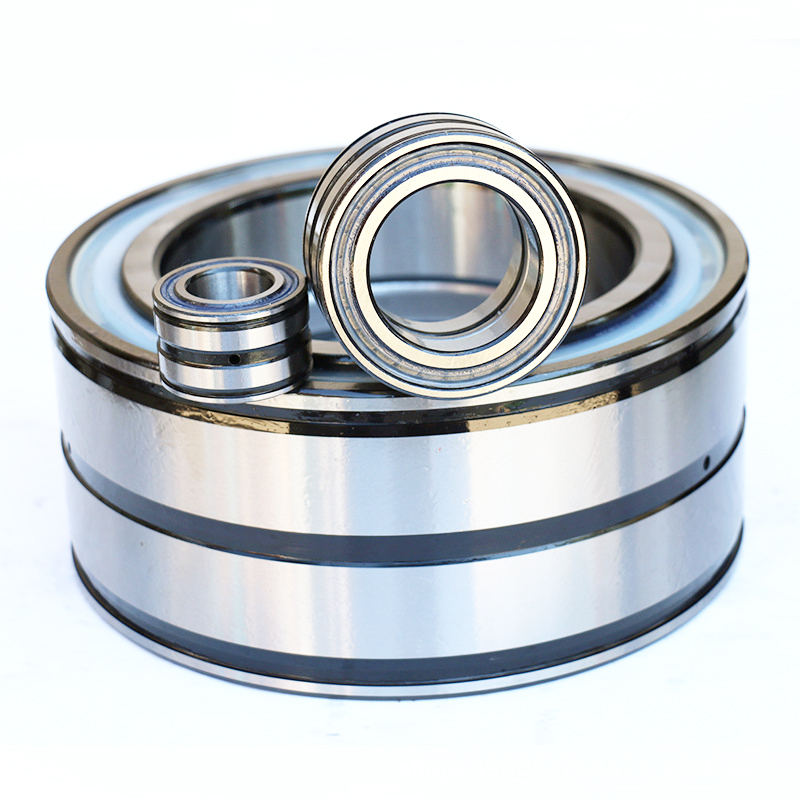 need to be able to withstand certain mechanical stresses and temperature changes while ensuring the normal operation of the system. The design of such bearings usually focuses on reliability, wear resistance, and corrosion resistance.
In summary, the design of bearings in different parts of an aeronautical engine requires comprehensive consideration of various factors such as material properties, working conditions, mechanical stresses, and temperature changes to ensure the efficient operation and long service life of the engine. With the development of aeronautical technology, the requirements for aeronautical bearings are also constantly increasing, and the future development of aeronautical bearing technology will pay more attention to lightweight, high performance, and high reliability.